Aadya – Thoraipakkam
How to Avoid Fraud When Buying Land in India
Investing in real estate remains the most reliable way to build multi-generational wealth in South India. However, the complexity of land records means that many buyers inadvertently walk into legal traps. Finding legitimate Land for Sale in Chennai requires more than just a budget and a preferred location. It requires a level of forensic investigation into the history of the soil. Fraudsters often exploit the emotional urgency of a “good deal” to bypass the necessary checks. If a seller is rushing you or offering a price significantly below the market rate, the risk of a title defect is almost a certainty. You are not just buying a square foot of earth. You are buying the legal right to occupy it.
The Foundation: Title Deed Verification
The most common fraud involves a seller who does not have clear authority to transfer the property. They might hold a copy of the deed while the original is mortgaged at a bank. You must insist on seeing the original title deed. If the seller claims the original is lost, proceed with extreme caution. A lost deed is a classic red flag for double selling or hidden encumbrances.
- Flow of Ownership: You need to trace the ownership back at least 30 years. This is the “Parent Document” check.
- The Link Documents: You need a complete, unbroken chain of transfer. If the land was gifted, inherited, or divided through a family settlement in the last few decades, those specific registered documents must be in your hands. A single missing link in this sequence makes your title legally vulnerable. Gaps in the paper trail are exactly where old claimants emerge years later to halt your construction.
- Power of Attorney (PoA) Scams: Buying through a PoA is a significant risk. If the principal has passed away or revoked the power without your knowledge, the sale deed you sign is worthless. It is a frequent feature of property scams in India. Always demand a “Life Certificate” of the principal dated on the day of registration. If the owner is in the same country, their physical presence at the Sub-Registrar’s office is the only way to be 100% certain.
- Minor’s Interest: Ancestral property often involves minor heirs. If a child was part of a previous inheritance cycle and the land was sold without a specific court order for that minor’s share, that person can challenge your ownership once they turn eighteen. This is a recurring legal nightmare in the Chennai market. You must verify that every minor’s interest in the history of the land was handled with judicial oversight.
Understanding DTCP and CMDA Approvals
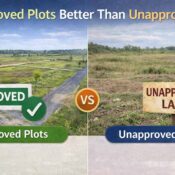
In the outskirts of the city, many developers sell “unapproved” layouts. These are agricultural lands that have been subdivided without the government’s permission to use them for residential purposes. These are technically illegal. If you buy into an unapproved layout, you will struggle to get a building plan approval later. You won’t get a bank loan either.
Reliable land buying tips in India always emphasize checking the approval number on the official CMDA or DTCP websites. Do not trust a rubber stamp on a piece of paper. Fraudsters often forge approval seals to convince buyers that the land is “ready to build.” When looking at Plots in Thandalam or other expanding suburban hubs, verify that the road width and open space reservations (OSR) comply with the latest norms. If the layout hasn’t gifted the roads to the local body, you might eventually find yourself blocked from accessing your own plot.
The Role of the Encumbrance Certificate (EC)
The EC is a record of all registered transactions on a property. While it is a vital tool, it is not a guarantee of a clean title. It only shows what has been registered. It won’t show an oral partition, a pending litigation that hasn’t reached an injunction, or an unregistered mortgage.
You should apply for an EC for the last 31 years. Look for any “Nil Encumbrance” statements carefully. Sometimes, a seller might provide an EC for a shorter period to hide a previous mortgage. One of the most important property buying tips in India is to obtain the EC yourself directly from the Sub-Registrar’s Office or the TNREGINET portal. Never rely on the copy provided by the seller. Compare the survey numbers and the boundaries mentioned in the EC with the title deed. Even a small typo in a survey number can mean you are legally buying a different piece of land than the one you are standing on.
Physical Verification and Boundary Issues
Demand that the seller survey and fence the plot before signing the agreement. This prevents boundary shifts later. Always publish a public notice in English and local newspapers to flush out hidden claimants. This step secures your legal standing as a bonafide purchaser. Visit the site alone. Neighbors often reveal the flooding history or family feuds that brokers hide. Finally, hire an independent surveyor to cross-reference the FMB sketch with ground reality. If the area is short or stones are missing, walk away. Brokers call it a clerical error, but it is usually a permanent legal nightmare.
The Patta: Proving Possession
Possession is a separate legal battle from ownership. While a sale deed records the transfer, the Patta is what the revenue department uses to recognize you. Never buy a plot if the Patta is not already in the seller’s name. This is a common entry point for property scams in India, where government-owned ‘Poramboke’ land or temple property is illegally carved into layouts.
Check the classification in the Adangal records. Avoid ‘Assigned Lands’ meant for specific communities. These carry strict, multi-decade non-saleable clauses. You risk immediate government repossession and a total loss of capital. In South Chennai, verify the land isn’t a ‘Tharisu’ (wasteland) or part of a lake bed. If the revenue records mark it as a water body, the building will be demolished eventually. No amount of paperwork can override a natural catchment area in the government’s eyes.
Financial Diligence and Payment Safety
Avoid cash transactions. The government has strict rules against cash payments for property over a certain limit. Use bank transfers for every rupee of the transaction. This creates a permanent trail.
Another one of the essential property buying tips in India is to ensure that the advance payment is kept to a minimum, usually not more than 10%, until the full due diligence is complete. If the seller demands a large cash advance “to settle a debt,” they might be planning to disappear. Also, check if the seller’s name matches exactly across the Aadhaar card, PAN card, and the title deed. Any discrepancy requires a gazette notification or a clarifying affidavit.
Why Pallikaranai and Kovilambakkam Require Extra Care
The high demand for land in the southern corridors has led to a surge in opportunistic developments. When searching for Land for Sale in Pallikaranai, you must be hyper-aware of the environmental regulations regarding the marshland. The boundaries of the protected eco-sensitive zones shift, and what was “safe” five years ago might be restricted now.
Always cross-reference your plot’s survey number with the list of prohibited lands for registration. Reliable land buying tips in India suggest that you should check the local municipal records for any pending tax arrears. Unpaid property tax for a decade can lead to a heavy penalty that the new owner will be forced to pay.
Buying land should be a clinical process, not an impulsive one. If the deal feels too perfect, it probably isn’t. The cost of a professional legal opinion is a fraction of the cost of a decades-long court battle. Take your time. Verify every signature. If the paperwork doesn’t align, walk away. There is always another plot, but your savings are finite.

Recent Posts

How Customers Evaluate Land Value Before Investing
Are Approved Plots Better Than Unapproved Land?