Aadya – Thoraipakkam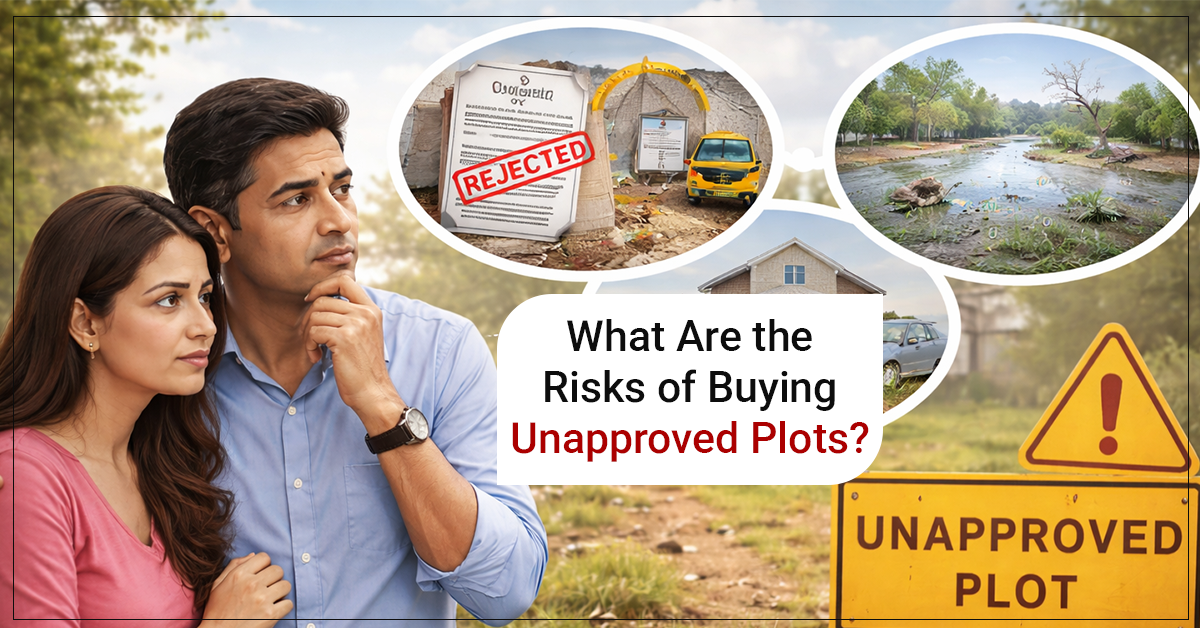
What Are the Risks of Buying Unapproved Plots?
Plots For Sale in Thandalam often look attractive on paper because unapproved land is typically priced 30–40% lower than DTCP or CMDA-approved layouts. That price gap is not a bargain; it is a risk premium. Unapproved plots are usually carved out of agricultural or residential land without sanctioned layout plans, road widths, or utility approvals. In practical terms, the buyer carries the risk the seller has stepped away from. These plots sit outside approved layouts, so drainage lines, EB connections, and municipal services are not guaranteed. If regulations change or regularisation stalls, the landowner has little legal recourse.
Legal Vulnerability: The Threat of Demolition and Encroachment
One of the most serious risks with unapproved plots is regulatory non-compliance. A registered sale deed only confirms ownership of land; it does not grant an automatic right to build. Construction permissions depend on whether the layout itself has been approved by the planning authority. This is where unapproved plots fail the test. Unlike dtcp approved plots or rera approved plots, these layouts sit outside sanctioned development norms, making any construction technically unlawful from day one.
Action usually starts during inspections tied to road expansion, drainage work, or master plan updates. If a structure sits on an unapproved layout, authorities can halt construction or issue removal notices. There is little room to contest because the layout itself lacks sanction. The exposure increases during public works. Since road widths and zoning were never formally reserved, land is taken at basic land value. Owners are compensated as if the plot was never developed, regardless of construction or improvements.
Financial Roadblocks: No Bank Loans or Refinancing
Banks do not fund land based on location alone. If the layout is DTCP unapproved, lenders treat it as non-compliant property. Without sanctioned roads or approved access, the file stops at the screening stage. Any history or risk of encroachment is enough for outright rejection. This is why both nationalised and private banks refuse to extend home loans or even basic land loans for such properties.
Paying in cash does not solve the problem. After purchase, construction funding is still blocked. Banks do not release building loans when the underlying land does not meet approval norms. This directly impacts future value. When it is time to sell, the same restrictions apply to the next buyer. The pool is limited to cash-only purchasers, which shrinks demand and forces discounted pricing. Over time, this lack of liquidity suppresses market value, regardless of the location or surrounding development.
Infrastructure Deficits: The “Plug-and-Play” Problem
The biggest operational gap in dtcp unapproved plots is infrastructure, or more accurately, the absence of it. These layouts are rarely planned with underground EB cabling, central sewage lines, or storm-water drains. What looks like open land during purchase later reveals itself as a site with no provision for basic services. Power connections are delayed or routed through temporary lines. Drainage depends on surface flow, which fails the moment surrounding areas develop.
The financial impact shows up after registration. Buyers who believed they saved money upfront often spend heavily on individual fixes. Deep borewells become necessary when no municipal water line exists. Septic tanks replace sewage systems that were never planned. Each solution is isolated, expensive, and harder to maintain over time. These are not optional upgrades; they are survival costs.
Road design is another weak point. Approved layouts mandate specific widths, usually between 24 and 30 feet, to allow fire engines, ambulances, and construction vehicles. In unapproved layouts, roads are often narrow, irregular, and poorly compacted. Once boundary walls go up, widening becomes impossible. Encroachment issues only worsen this, gradually reducing access and usability. What was sold as a residential plot ends up functioning like an improvised settlement, not a planned neighborhood.
The Patta and Documentation Trap
Many buyers assume that a Patta is enough to proceed with construction. It is not. A Patta only establishes individual ownership; it does not replace layout approval. The confusion arises when sellers present Patta as proof of legality, even though the overall development remains unapproved. This is the clear line separating dtcp approved plots and rera approved plots from informal layouts that operate outside planning control.
These issues usually emerge during verification, not at sale. In many layouts, the parent land was never formally converted from agricultural use. That missing conversion blocks approvals later, and banks flag it immediately during loan or resale checks.
There is also no regulatory safety net. Unapproved plots do not fall under RERA oversight, which means buyers cannot approach the authority if commitments are abandoned or infrastructure is left incomplete. At that point, the only option is prolonged civil litigation, with uncertain outcomes and long timelines.
Development Charges and Regularization Fees
Buyers of dtcp unapproved plots often assume that future regularization will be simple and inexpensive. In reality, regularization schemes shift the financial burden entirely onto the landowner. When the government opens a layout or OSR regularization window, owners are required to pay development charges to bring the land in line with planning norms. These charges cover roads, open space reservations, and infrastructure that should have been executed at the layout stage. This is the cost difference between informal layouts and dtcp approved plots or rera approved plots.
The calculation method is where buyers get hit. Regularization fees are not linked to what you paid for the plot. Authorities apply current guideline values and prevailing rates. Penalties are added separately. When all components are tallied, the amount payable can come close to the land’s purchase cost. There is also no assurance that payment guarantees approval, only eligibility for consideration.
Quality of Life and Neighborhood Standards
A Plot in Pallikaranai may look livable on day one, but long-term quality depends on how the layout was planned. In unapproved developments, growth is reactive. There is no sanctioned plan that earmarks space for parks, OSR land, or community facilities. Every available parcel gets built over, leaving no buffers for light, ventilation, or shared movement. Over time, this creates congested streets and irregular access, not a residential neighborhood.
Environmental risk is the second fault line. Many unapproved layouts are carved out of low-lying parcels or reclaimed water bodies because those parcels are cheaper to acquire and faster to convert informally. The result shows up during monsoon seasons. Water has nowhere to drain. Roads flood, foundations stay damp, and sewage systems backflow. With heavier and less predictable rainfall, water-logging in such layouts is no longer an occasional issue. It shows up every season, affecting access, structural stability, and whether the property remains livable or saleable.
Conclusion: Why Approved Plots Are the Only Real Investment
The numbers may tempt you to look elsewhere, but the logic is simple. Approved land costs more because the risk has already been removed. When you evaluate Villa Plots for Sale in Chennai through a long-term lens, approval status is not a checkbox; it is the foundation of value. An approved plot gives you access to bank funding, predictable construction timelines, and infrastructure that works from day one. Roads are usable, utilities are planned, and ownership is defensible.
This is where things to check before buying a plot become non-negotiable. DTCP or CMDA approval confirms that the layout meets planning norms. RERA registration creates enforceable obligations after registration. Without it, the buyer has no regulatory fallback.
Buying into a verified project removes uncertainty from the transaction. The approvals are already in place, infrastructure is executed, and the land can be built on without waiting for future schemes or corrections. Value comes from clarity, not from expecting issues to be fixed later.

Recent Posts

How Customers Evaluate Land Value Before Investing
Are Approved Plots Better Than Unapproved Land?